
 IONIZER AIR PURIFIER
 Negative ions, explained
Particles behave differently when they carry a charge.
Ionization is a simple idea with a useful effect: negative ions attach to airborne particles, helping those particles come together, settle, or adhere to nearby surfaces instead of remaining suspended in the room air.
The basic science
So, what is a negative ion?
An ion is an atom or molecule with an electric charge. A negative ion has gained an electron. In room air, it can interact with suspended particles and change how those particles move.
Create the charge
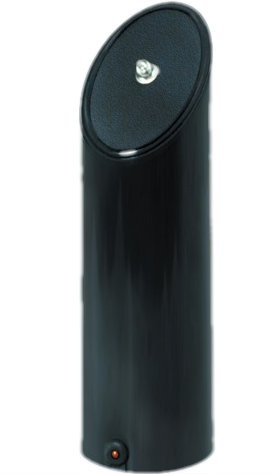
EnergAire uses an electronic ionization process to generate and disperse negative ions into the surrounding air.
Attach to particles
The ions can attach to airborne particulate matter such as smoke, dust, pollen, and other fine particles.
Settle or collect
Charged particles can attract one another, settle faster, or adhere to nearby surfaces. Regular dusting or vacuuming remains part of the process.
A different path through the room
Ionization does not wait for every particle to reach a filter.
A mechanical purifier captures particles that pass through its filter. Ionization changes the electrical behavior of particles in the surrounding room air, so it can act outside a filter housing. That does not make every ionizer equally effective: airflow, placement, particle composition, ion concentration, and surface cleaning all matter.
- Particle focused: ionization is intended for airborne particulate matter, not gases or odors.
- Quiet by design: EnergAire does not use a fan to pull room air through a filter.
- Simple routine: there is no filter, cartridge, or bag to order and replace.
Particle-size map
How small are the particles?
The chart uses a logarithmic scale because particle sizes span several orders of magnitude. It shows common particle-size ranges alongside the EnergAire ionization reference.
Particles and air-cleaning range
Diameter shown in microns. One micron is one-thousandth of a millimeter.
*How to read the EnergAire band: the highlighted band is a particle-size reference based on the product description that EnergAire can address particles as small as .001 micron. It is not a universal removal-efficiency curve. Real-world results depend on particle composition, charge, room airflow, placement, operating time, and where charged particles ultimately settle.
The chart is an educational size comparison informed by the particle-size comparison in the EnergAire product literature and the EPA technical summary of residential air cleaners.
Clear expectations
What ionization can do – and what it cannot.
Good air-quality information should make the boundaries clear. Ionization is a particle-control approach, not a replacement for ventilation or source control.
What ionization can help with
Negative ions can charge suspended particulate matter, helping particles aggregate, settle, or adhere to room surfaces.
- Dust and fine dust
- Pollen and other larger airborne particles
- Smoke and combustion-related particles
- Fine and ultrafine particulate matter, depending on conditions
What ionization does not do by itself
Charging a particle is not the same as destroying it. EnergAire is not a gas-phase filter or a disinfecting device.
- It does not remove gases, VOCs, or odors
- It does not replace fresh-air ventilation
- It does not eliminate the need for cleaning settled dust
- Particle size is not proof that a biological organism has been inactivated
The EPA explains that ionizers charge particles so they can attach to surfaces or settle faster, while also noting that ionizers do not remove gases or odors and that performance varies by device and operating conditions. Read the EPA overview.
Keep exploring
Reliable information, beyond the product page.
Negative ions are often discussed in broad wellness language. These links are here so you can look at the technology, particle control, ozone questions, and the research on mood outcomes for yourself.
How ionizers charge particles, plus the limits around gases, odors, and ozone.
A deeper reference on filters, ionizers, particle size, efficiency, and effectiveness.
A peer-reviewed review and meta-analysis; useful context for wellness claims about negative ions.
An external reference for checking device certification related to ozone emissions.
A clearer way to think about room air.
Use EnergAire for particle-focused ionization, keep room air moving when helpful, and pair it with source control and ventilation for a complete approach.