


Lean Japan leads to American Six Sigma
Welcome back to WISDOM WEDNESDAY where we share some insights of the electronics manufacturing industry. Today we’ll take a look at the roots of two different yet overlapping pursuits of quality, one Japanese and the other American. Wisdom Wednesday is sponsored by Micron Corporation that brings you precision electronics at a Micron level.
Last week we were introduced to Taiichi Ohno and the Toyota Production System (TPS) which utilizes a methodology known as 5S. That company specific system encompasses much more than just 5S. In the 1980s the entirety of TPS became known across the globe as Lean Manufacturing. Lean is an operational philosophy that seeks to maximize customer value by eliminating waste. TPS was a major Japanese development after WWII and yet it’s beginnings were initiated from an American installed governor general of Japan named General Douglas McArthur.
At the time of the end of the war there was a body of understanding that had recently been invented and developed in the United States known as Statistical Quality Control (SQC). Three people dominated the effort to establish that field of knowledge. Walter A. Shewhart the pioneer inventor of SQC, W. Edwards Deming who championed the spread of SQC to Japan and throughout the world, and Joseph M. Juran whose strategy shifted the focus of SQC to its managerial and human applications. These men were Americans: Shewhart was born in New Canton, Illinois; Deming in Sioux City, Iowa; Juran, born in Romania, immigrated to Minneapolis, MN when he was seven. While the military had embraced the concepts of SQC during the war, the industrial complex in the States, after the war, largely ignored it. This was because they had adopted methods of mass production focused on the speed and volume of production. Nonetheless, at the behest of General McArthur SQC was introduced to Japan.
Japanese industry had earned a reputation for low-quality, low-cost products such as toys. That changed after the introduction of SQC (amongst many other factors). By the 1970s and 1980s Japan was recognized as producing high-quality products in areas such as computer chips, electronic devices, and automobiles. The American military was an early adopter of Japanese vehicles. It is not an overstatement to say that SQC helped transform the quality of a nation’s products.
Flash forward to Motorola Headquarters at Schaumburg, IL in the year 1986. CEO Bob Galvin had previously directed engineer Bill Smith and Dr. Mikel J. Harry to drastically reduce the number of defects in Motorola products by minimizing variation to a severe degree. They were doing this to compete with significant global competition. In this way, one might see how SQC had begun to rear its head back in the states after a long stay on an island located in the South Pacific. What they produced was labelled Six Sigma. The moniker refers to a comparison of the standard deviation of a sample to the standard deviation of the population the sample was taken from. Certain other factors need to be specified first, but the specification of plus or minus 6 sigma implies a defect rate of 3.4 per million parts produced. Think about that for a moment, only three or four parts deviating enough to be called a defect in one million attempts. I don’t know about you but I can’t get past my second cup of coffee without making at least one mistake. Six Sigma is a business management strategy that seeks to improve product quality by minimizing variation. It is employed throughout the world and is widely accepted as an essential set of analysis tools for manufacturing.
Let’s trace the travel of SQC from one side of the Pacific Ocean to the other and back again using one SQC tool as an example. Shewhart created a four-step repeating model of continuous process and product improvement referred to by the acronym PDCA, standing for Plan-Do-Check-Act. Deming brought the model with him when he first visited Japan in 1950. Juran followed in 1954. They “ate it up,” implemented it, perfected it, and “spit it back out” across the Pacific to the United States in the form of what became known as Lean Manufacturing. Zooming back to Illinois and Motorola, PDCA was implemented by Smith and Harry as one of the basic tenets of Six Sigma.
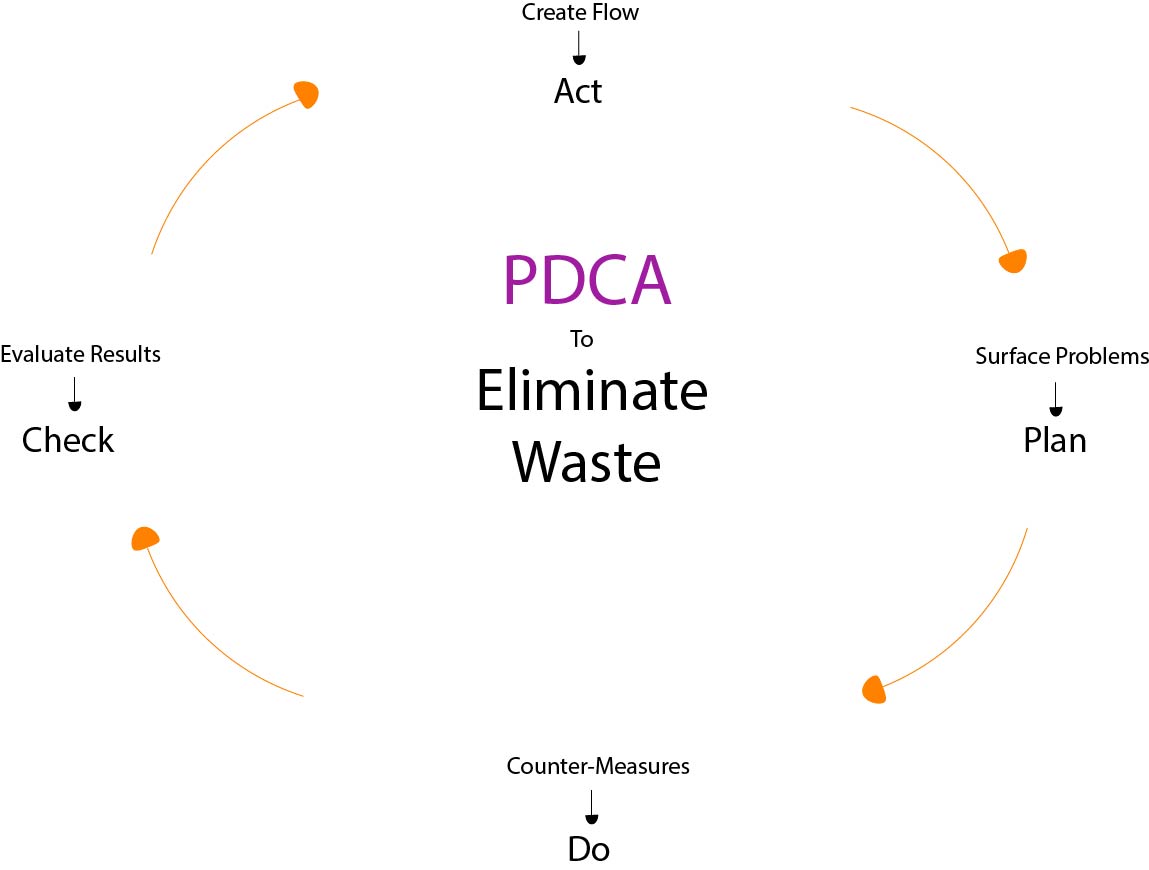
Figure 1 gives one representation of how PDCA is used to Eliminate Waste. It reads as follows. When problems come to the surface that are wasteful, come up with a PLAN. Establish the necessary countermeasures and DO them. Evaluate the results of the countermeasures by CHECKing them. Create a flow of action based on the evaluation and ACT. The circular process is repeated until the original wasteful problem has been eliminated.
PDCA is just one example of knowledge that passed from the United States to Japan and then back stateside again. It is a wonderful example of the success of a pluralistic understanding of manufacturing principles in bettering entire industries, and dare I say, nations.
Figure 1. Using PDCA to Eliminate Waste
We’ve come to the end of another edition of Wisdom Wednesday! We sincerely hope you’ve all learned something new and interesting. MICRON CORPORATION hopes you’ll come visit us again to share and learn.