
What Should Your Electronics
Test Actually Prove?
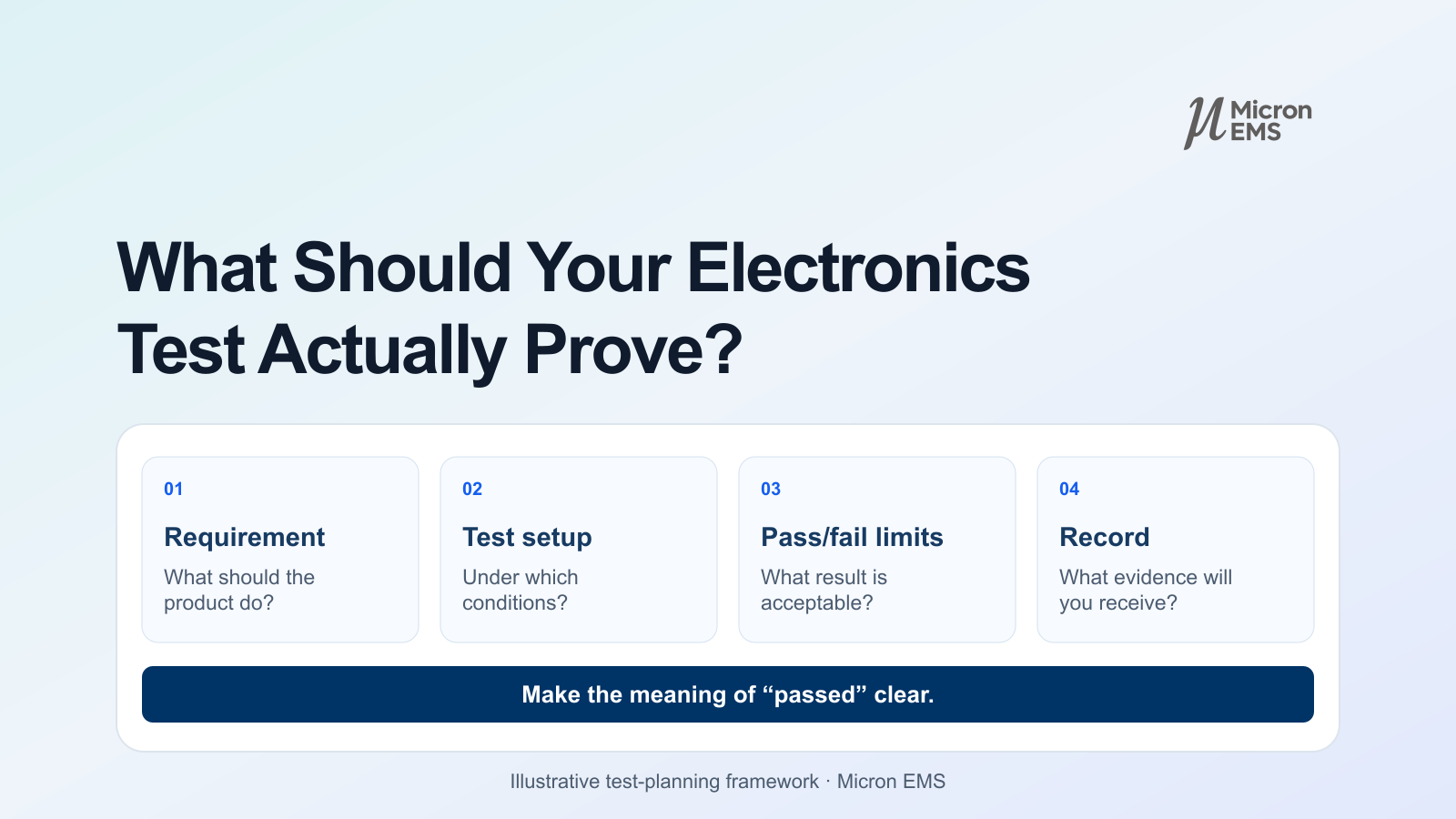
A passing result should tell you what was checked, under which conditions, and against which requirements. Here is how to agree on a useful electronics test plan with your manufacturing partner.
A useful test result answers a specific product question.
Your board powers on. A status light appears. The test report says “pass.” Those observations may be useful, but what do they tell you about the functions your customer will depend on?
An electronics test plan connects the product requirements you want checked to the method, conditions, acceptance limits, and records used to check them. Acceptance limits describe which outcomes count as a pass. Agreeing on those details with your contract manufacturer (CM) helps both teams understand what the result means.
Our article on reviewing the first finished unit explains an early build checkpoint. This follow-up looks more closely at the test evidence behind that review, whether your team already has a procedure or is working out what to ask for.
Explain what the product needs to do, including its important interfaces and operating conditions.
Define the checks, pass/fail limits, and results your team needs to receive.
Confirm which requirements the planned tests address and which need another form of verification.
Describe the behavior your customer depends on.
Before choosing equipment or asking for a “full functional test,” describe the product in use. What powers it? What does it connect to? Which inputs should produce which outputs? What would prevent your customer from installing or using it successfully?
If you already have approved specifications and test procedures, share their current revisions with your manufacturer. If you have a working prototype and a description of the intended behavior, start there. Identify what is established, what is still an assumption, and who can approve the remaining requirements.
You do not need to arrive with every fixture designed. You do need to agree who will develop the procedure, supply the equipment, set the acceptance limits, and approve the plan. A fixture is simply the tooling and connections that hold or connect the unit during a test. Its development, maintenance, and ownership can affect cost and schedule.
Six questions for your electronics test plan.
Use these questions when reviewing a quote, preparing a first build, or updating an existing test process. The answers should describe the product you are actually ordering.
Which product configuration will be tested?
Identify the board or assembly revision, approved parts, firmware, and settings. Firmware is the software loaded into the electronics. If the order includes several versions, ask how each version will be selected and checked. A result from one configuration may not cover another.
Which functions and conditions will the checks cover?
List the inputs, outputs, communications, and operating modes that matter. Include the relevant power supply, connected equipment, loads, timing, and environment. A load is what an output drives or supplies power to. Agree which real conditions the setup represents and which remain outside its scope.
What exactly counts as a pass?
Replace “works correctly” with approved expected outcomes. Where a measurement matters, define the units, acceptable range, and when the reading is taken. Where the check is an observed behavior, describe that behavior clearly. Have the responsible engineer approve limits and confirm that the measurement method can distinguish acceptable from unacceptable results.
How will the method produce a trustworthy result?
Agree the procedure, connection points, equipment, software, and setup checks. Discuss calibration where measurements require it and how the fixture itself will be checked. If you supply a working reference unit, identify its approved configuration and purpose. A reference unit can help verify a setup; it does not replace written acceptance limits.
Which units receive which checks?
Confirm whether a check applies to every unit, selected samples, or an engineering build. Ask which variants and product stages are included. “Every unit tested” describes the quantity receiving a test; it does not by itself describe the functions, conditions, or possible defects covered.
What records and failure information will you receive?
Agree how results connect to a serial number or production lot, what measurements are retained, and how long records are kept. Specify what happens after a failure, who approves corrective work, and which checks must be repeated. Retest results should remain connected to the original finding and any work performed.
It starts up. Does its output do the job?
Imagine you are ordering a controller that reads an input and drives an external device. A power-on check confirms that it starts and displays a status light. Your customer, however, depends on the controller responding correctly through its output connector while driving the intended load.
That requires a more specific discussion. Which input will the test apply? What load will be connected? What output response should be measured, within what limits, and after what interval? Does the check include the installed wiring or only the board?
Once those details are approved, the procedure can check the required response and keep an identified result. The power-on check still has a role. The additional check supplies evidence about the behavior the customer needs.
This is an illustrative scenario, not a Micron customer result. Actual values and conditions must come from your product requirements and engineering review.
Match each check to the question it can answer.
Visual inspection, circuit-level checks, and functional testing provide different kinds of evidence. Our guide to AOI, X-ray, in-circuit, and functional test explains those methods. For your project, ask how the proposed combination addresses the requirements and risks you have identified.
A functional test checks behavior under its defined conditions. A routine production check does not, by itself, establish performance in every environment, long-term reliability, or product certification. Discuss any separate design verification, qualification, or compliance work your product needs and who will perform it.
NASA’s product verification guidance links specified requirements to planned methods, acceptance criteria, and recorded evidence. It also distinguishes acceptance activities from broader verification and qualification. That is a useful planning principle for a commercial build: be clear about the question each activity answers.
| If the plan says… | Ask your manufacturer… |
|---|---|
| “Functional test” | Which functions, configurations, and conditions are included, and what defines a pass? |
| “100% tested” | Which checks will every unit receive, and what requirements remain outside those checks? |
| “Test report included” | What will the report contain, how will it identify the units, and are measurements or only pass/fail results retained? |
Prepare a short test brief for your CM.
Share the information you have. Mark unfinished items clearly so both teams can agree what needs developing before production.
Files, versions, and variants.
Current drawings, parts list, software, settings, and the board or finished assembly you want delivered.
Functions and important conditions.
Intended behavior, connected equipment, power, loads, interfaces, and known concerns from prototypes or earlier builds.
Requirements and pass/fail criteria.
Existing procedures and approved limits, plus open questions and the person authorized to resolve them.
Equipment and development needs.
Available fixtures, cables, software, reference units, and any procedure or tooling work that still needs quoting.
Results you need to keep.
Unit or lot identification, measurements, report format, retention period, and how failures and retests will be documented.
Scope, responsibility, and approval.
Who supplies and approves each item, which units are checked, what remains outside the plan, and the effect on timing and cost.
A useful closing question: “If this unit passes, can we both explain what the result demonstrates and what still needs to be checked?”
Before you hand over the test requirements.
Can I start without a finished test procedure?
Yes. Explain what the product should do and share your drawings, prototype information, and known requirements. Ask what engineering work is needed, who will do it, and how the procedure and limits will be approved. Our EMS quote preparation guide can help you organize the initial handoff.
Will passing production tests prove the design is ready for every use?
A pass provides evidence for the checks performed under the specified conditions. Discuss separately whether your product needs design validation, environmental testing, reliability work, or regulatory assessment. Confirm the responsibility and scope of those activities before assuming they are included in the manufacturing quote.
What if a unit fails once and then passes a retest?
Ask how the original failure was investigated, whether a setup problem or corrective work was identified, and which checks were repeated. The final acceptance decision should follow the agreed procedure and retain the relevant history. An unexplained failure deserves attention even when a later result is a pass.
Should the test plan change when the product changes?
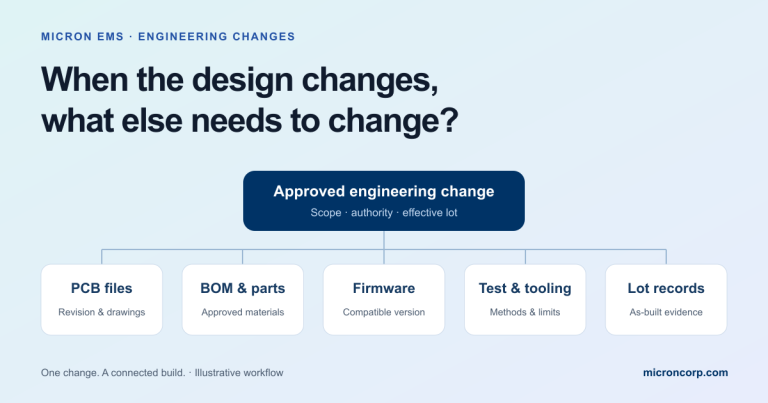
Review the impact whenever hardware, firmware, components, or intended behavior changes. Some changes leave the existing method suitable; others require different limits, fixtures, software, or checks. Agree the approved revision and when it takes effect. Our engineering change guide explains how to keep the build information aligned.
Connect the test plan to your build.
Agree what you will receive, examine, and approve at an early build checkpoint.
Read the article →Inspection and testingUnderstand what each method catches.See how visual, X-ray, circuit-level, and functional checks contribute different evidence.
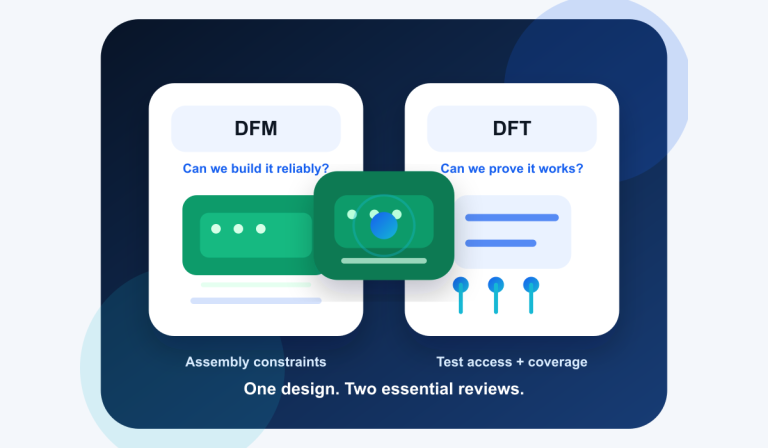
Read the article →Plan access earlyMake the product easier to test.Explore how design for testability supports fixtures, access, and a clearer manufacturing handoff.
Read the article →