
Two Electronics Quotes.
Are They Pricing the Same Build?
A practical guide to comparing electronics manufacturing quotes—materials, setup, testing, programming, documentation, and delivery—before you compare the total.
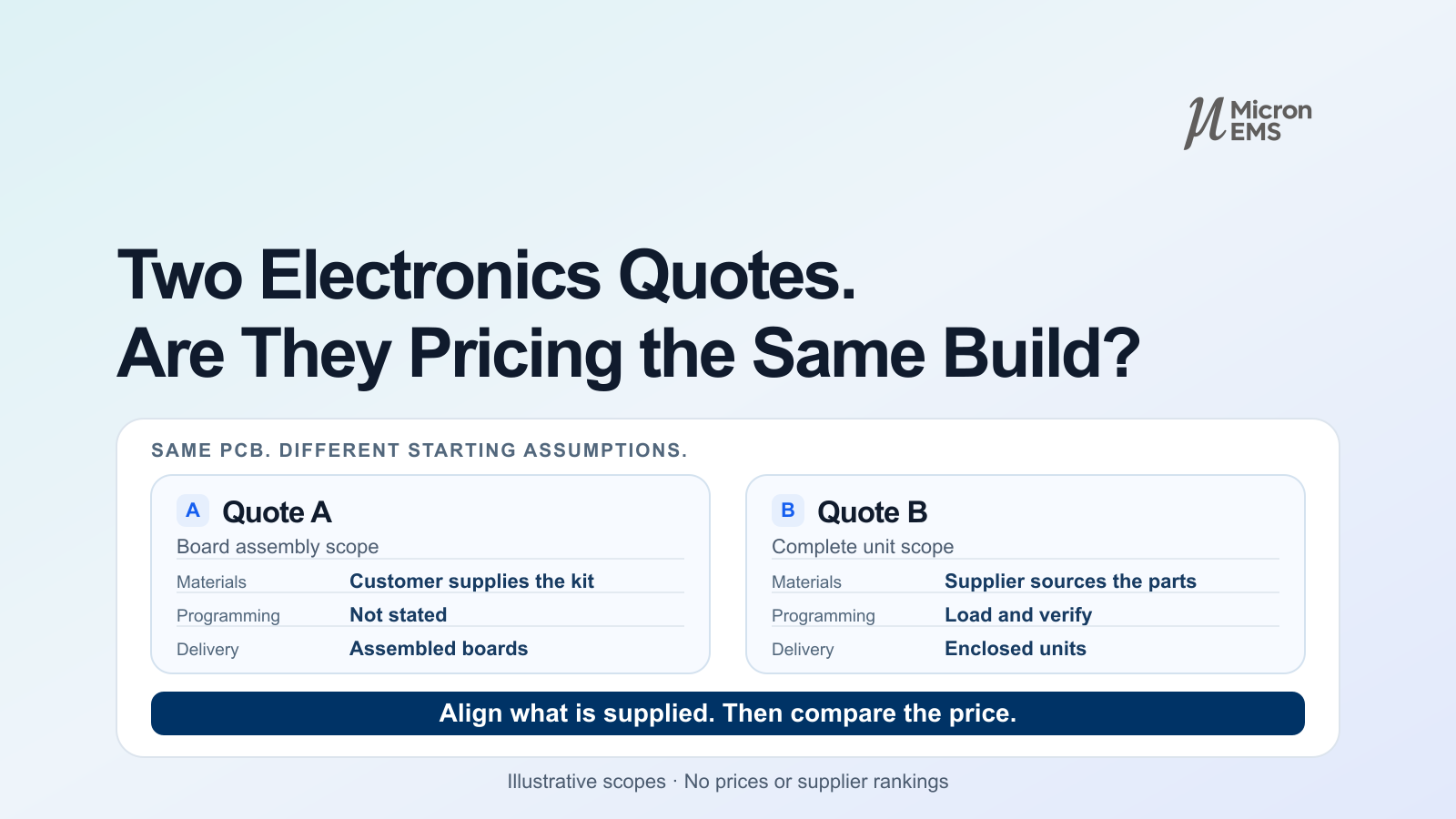
Quote A
Board assembly scope
- Materials
- Customer supplies the kit
- Programming
- Not stated
- Delivery
- Assembled boards
Quote B
Complete unit scope
- Materials
- Supplier sources the parts
- Programming
- Load and verify
- Delivery
- Enclosed units
A useful price comparison starts with a shared scope.
Two quotes arrive for the same electronics project. Their totals differ. Before choosing between them, check whether they cover the same revision, quantity, materials, verification, and deliverable.
A lower quote may reflect an efficient process, a different buying model, or a smaller scope. A higher quote may include additional work—or simply carry a different price. Clarifying the differences gives you a stronger basis for the decision.
Our recent article on turning a board into a finished product explored the complete assembly. This week, we apply that thinking to the purchasing conversation: are both suppliers pricing the work your team actually needs?
Use the same files, revision, quantity, and delivery configuration.
Distinguish recurring work, one-time items, and costs outside the quote.
Ask for written clarification where an item is missing or ambiguous.
“The same board” can still mean different projects.
Start by identifying what the receiving team needs: an assembled printed circuit board, a programmed and tested subassembly, or an enclosed unit with accessories and packaging. That endpoint determines which work belongs in the comparison.
Send each supplier the same controlled file package and identify the quantity for this order. Separate the current release from an annual forecast or a possible future run. Different quantity assumptions can make a unit-price comparison misleading.
Record any accepted differences beside the quote. You may deliberately choose to supply material or complete final integration yourself. Make that remaining work visible so it stays part of the decision.
Six checks before comparing the prices.
These questions help engineering, purchasing, and manufacturing review the same scope. They also make follow-up discussions more specific.
Revision, quantity, and release pattern
Confirm the assembly identifier, approved file revisions, order quantity, and any scheduled releases. Ask which assumptions support each quantity break. A price based on a larger future purchase should remain distinguishable from the price for the order you are ready to place.
Material supply and responsibility
Does the quote include bare-board fabrication and components, or does it assume a customer-supplied kit? Clarify approved alternatives, setup quantities, shortages, and any minimum-purchase or excess-material charges. Our turnkey, consigned, and hybrid guide explains the different sourcing responsibilities.
Setup, tooling, and nonrecurring work
Identify stencils, machine programming, fixtures, test development, and other one-time work. Ask what is included, what is separate, and what could need updating after a design change. Confirm any agreed reuse, storage, and ownership arrangements rather than assuming the next order will have no setup costs.
Inspection, test, and programming
Compare the specified methods and coverage, firmware loading, configuration, and required result records. A general “test included” note may need a more precise description of the checks and acceptance criteria. Review any fixture or test-development work separately from running the agreed test on each unit.
Integration, documentation, and pack-out
Check whether both quotes include the enclosure, harness, mechanical assembly, labels, serialization, required reports, accessories, and protective packaging. A quote for PCB assemblies and a quote for complete units may both be appropriate responses to different interpretations of the request.
Delivery basis and quote conditions
Ask what starts the lead-time clock: order acceptance, complete material receipt, approved files, or another milestone. Confirm whether delivery means shipment or arrival. Review quote validity, currency, payment assumptions, freight, and any stated exclusions or separately assessed charges.
Two reasonable quotes. Two different endpoints.
Imagine a controller project that needs programmed electronics inside an enclosure. Both suppliers receive the PCB files, but the request leaves material ownership and final integration unclear.
Quote A assumes the customer provides the kit and receives assembled boards. Quote B includes sourcing, firmware loading, and enclosure integration. The quotes do not yet describe the same delivery.
| Comparison item | Quote A assumes | Quote B assumes |
|---|---|---|
| Material | Customer supplies the kit | Supplier sources the specified parts |
| Programming | No programming scope stated | Approved firmware loaded and verified |
| Deliverable | Assembled PCBAs | Enclosed units |
| Setup charges | Listed as separate items | Grouped; breakdown needed |
Ask both suppliers to respond to the same revised scope. If your team prefers to retain some operations, define those operations consistently and account for the work your team will perform. Then compare the clarified quotes.
Neither column establishes better quality or better value. The example shows why a total alone cannot resolve a scope difference.
This illustration uses no actual supplier quotes, customer information, or prices.
Keep the first order and the repeat order distinct.
A per-unit figure can leave one-time development, setup, or required external purchases outside the headline number. Compare the complete quoted amount for the same quantity and scope, including the applicable separate charges.
For a repeat-order view, identify only the charges the supplier has confirmed can be reused or avoided. A changed board, firmware image, fixture, or test requirement may change that assumption. Keep unconfirmed future savings out of the current comparison.
List customer-purchased material and remaining internal operations separately. Check that a charge has not already been included elsewhere before adding it again. Where a cost remains unknown, show it as pending.
A practical comparison: the quoted work for the same lot and deliverable, plus applicable one-time and separately priced requirements, with customer responsibilities shown alongside.
Use that view to discuss the differences. Select the supplier whose confirmed scope, capability, delivery plan, and price fit the program.
A quote-review checklist worth sharing.
Match the files and quantity.
Confirm the assembly, revision, order size, release pattern, and required delivery configuration.
Name who supplies each item.
Include boards, components, enclosures, harnesses, fixtures, software, and any customer-supplied material.
Define the work and evidence.
Align assembly, inspection, test, programming, records, labels, accessories, and pack-out requirements.
Separate recurring and one-time costs.
Identify setup, tooling, development, minimum buys, and separately priced items without double counting.
Clarify the delivery assumptions.
Record the lead-time starting point, material and approval dependencies, shipment basis, and quote validity.
Close the open questions in writing.
Keep the clarified scope and supplier responses with the quote used for the purchasing decision.
A useful request: “Please confirm what is included, what is priced separately, what our team must supply, and which assumptions could change the price or delivery.”
Make the comparison useful.
Does a lower quote mean a lower-quality build?
No. Price can reflect process efficiency, sourcing, quantity, scope, and other assumptions. Confirm the requirements and evaluate the supplier’s ability to meet them before drawing a conclusion.
Can I compare a turnkey quote with a consigned quote?
Yes, when you make the responsibilities and costs visible on both sides. Include customer-purchased material and any remaining work in the comparison, using confirmed information and avoiding duplicate charges.
What if an important item is missing from the quote?
Ask for written clarification or a revised quote. Mark the item as unresolved until the supplier confirms its treatment. A missing line should not silently become an included item or a zero-cost assumption.
Connect the quote to the work behind it.
Gather the files and project context that help an EMS partner understand the scope.
Read the article →The finished productDefine the delivery endpoint.Follow the board through wiring, enclosure integration, verification, and pack-out.
Read the article →Material ownershipChoose a workable sourcing model.Understand where customer and manufacturing responsibilities meet.
Read the article →