
Before You Build the Rest:
Reviewing the First Finished Unit
A first finished unit review helps you and your contract manufacturer confirm the product, review the results, and agree what happens before more units are built.
Make sure the completed unit matches the product you expect.
You may already have a complete manufacturing package, or you may be preparing to hand over a design for the first time. In either case, an early look at the finished assembly can help you and your contract manufacturer (CM) confirm how the product comes together before more units follow.
A first finished unit review is a planned check of an early completed assembly against requirements you agree together. It gives you a chance to review the intended version, fit, operation, identification, and delivery details, then record what may proceed and what needs attention.
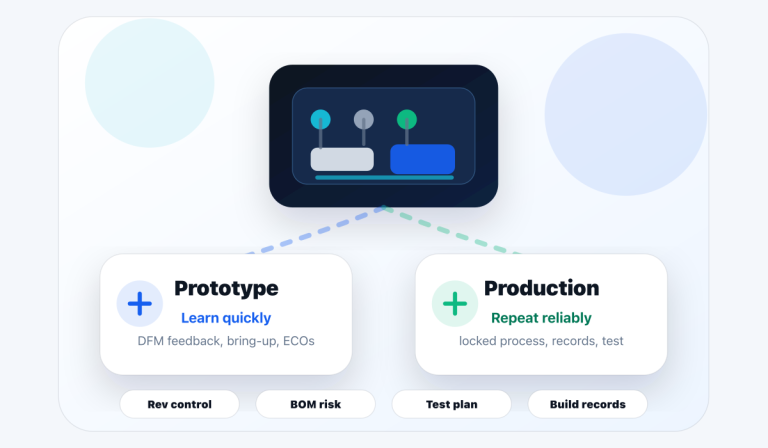
Our recent article on carrying learning into the next production run explored the records worth keeping. Here, we focus on what you should discuss with your manufacturer before reviewing the first completed unit.
Explain what the finished product should do and what you expect to receive.
Identify the checks, results, photos, or sample your team needs to see.
Decide who can respond, what needs approval, and how the decision will be recorded.
Agree on what you will receive, review, and approve.
Start with the delivery you need. Are you buying assembled circuit boards, a programmed subassembly, or complete units in enclosures? If you expect a finished product, reviewing the board alone will leave questions about wiring, fit, labels, and packaging unanswered.
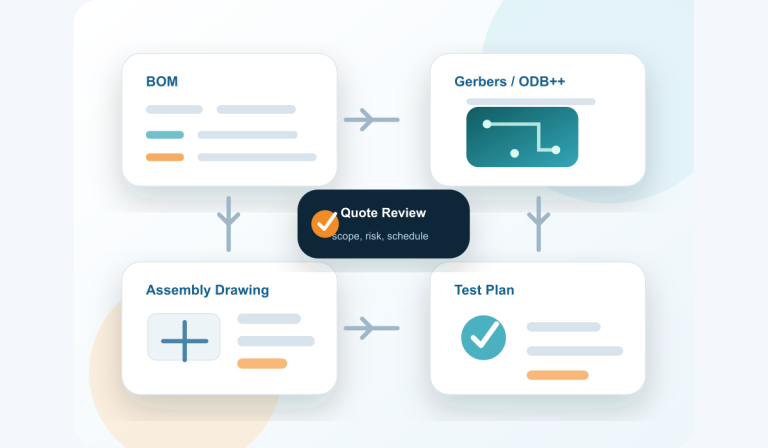
If your build package is established, use its approved drawings, parts list, software, and test requirements as the starting point. If those details are still coming together, share what you have and ask your manufacturer to identify the missing information and decisions needed before work begins.
Agree when the review will happen and what your CM will send: inspection or test results, identified photographs, a physical sample, or a combination. Name your reviewer, allow time for a response, and confirm which work, if any, must wait for approval.
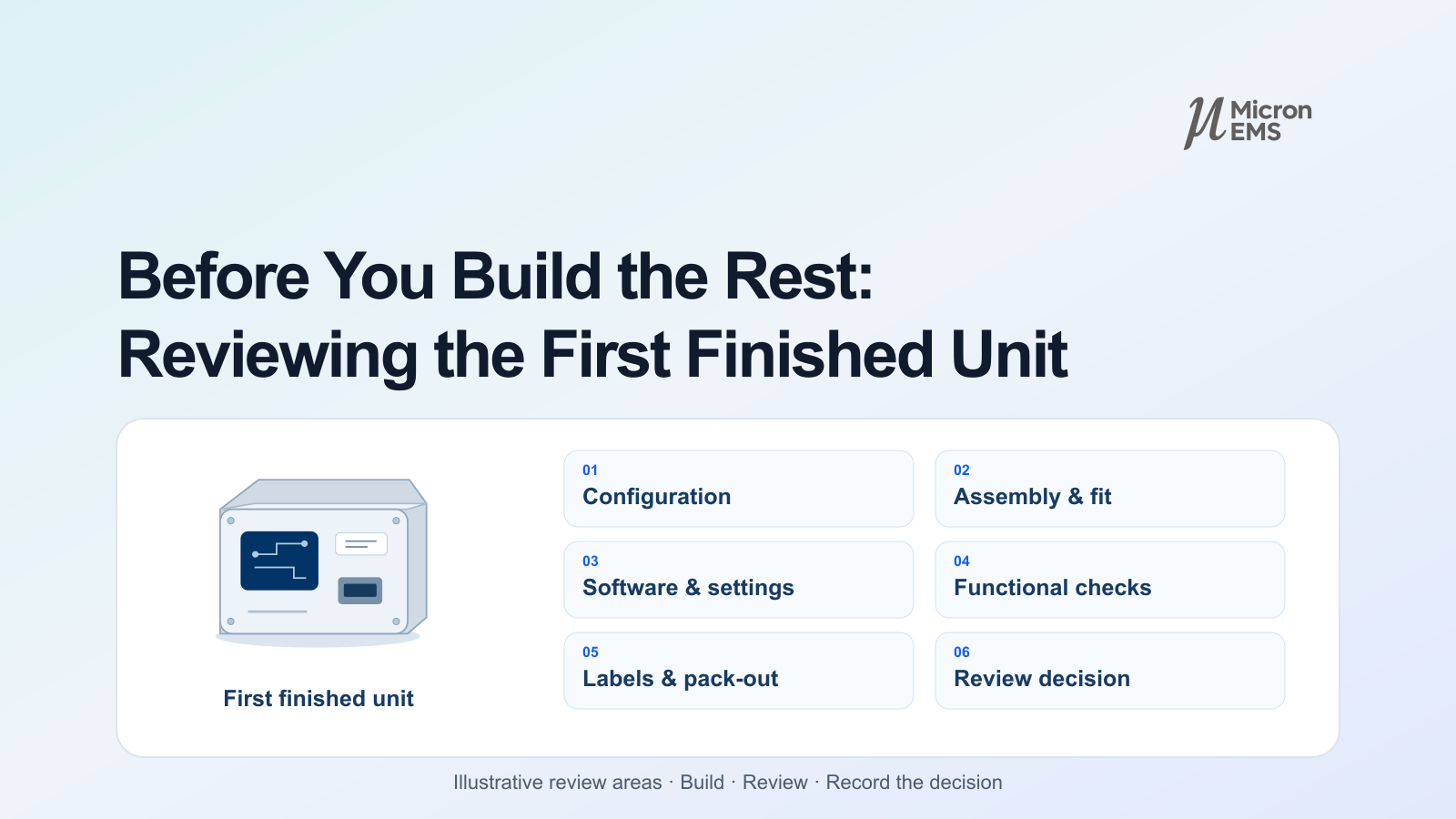
Six questions for your first finished unit review.
Use these questions to agree the review with your CM. Your team supplies the product expectations and approvals it owns; your manufacturer explains the build process and provides the agreed evidence.
Is this the product version you agreed to build?
Ask which board, bill of materials (the parts list), drawings, software, and test instructions apply to the unit. Confirm any approved component alternatives. If the sample uses a temporary method or differs from the planned production build, ask what that difference means for the remaining units.
Does the assembly fit the way you need it to?
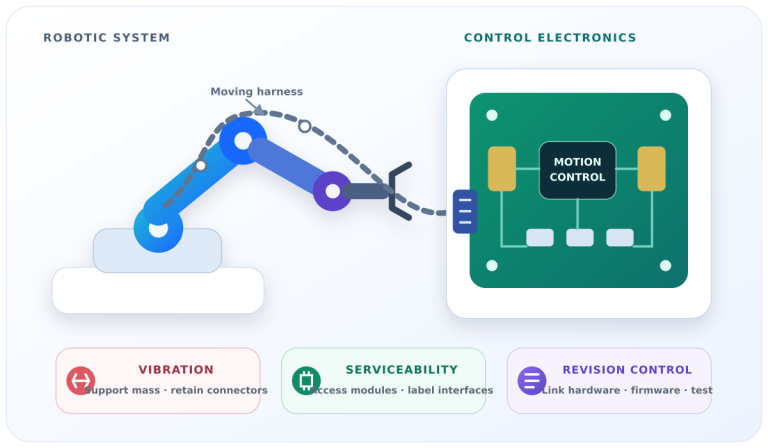
Review connector positions, mounting, cable routing, access, and enclosure fit against your product requirements. Tell your manufacturer about installation constraints it may not see on the bench. Ask for photos of important internal details before closure. Our finished-product guide explains how these details connect beyond the board.
Does it have the right software and settings?
If your product uses firmware, the software loaded into the electronics, identify the approved version and settings your CM should use. Ask how the loaded version is checked. Include serial numbers, device-specific data, or calibration requirements where applicable, and clarify which information your team must supply.
Do the results show the functions you need?
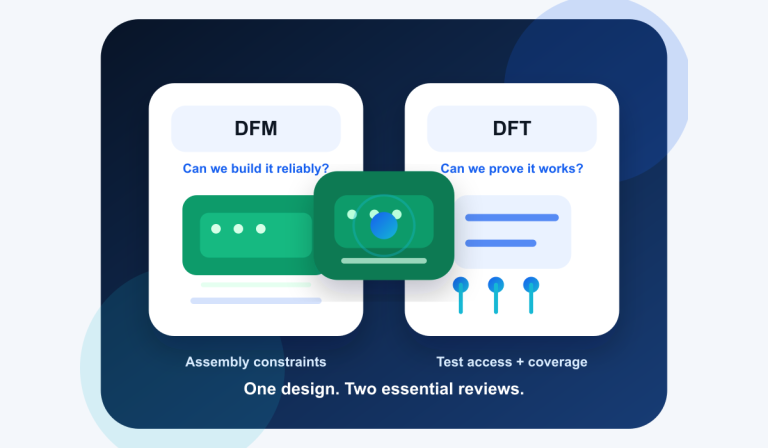
Agree which functions will be checked, what counts as a pass, and which results you will receive. If you have a test procedure, share it. If you only know the behavior you need, describe it and agree who will develop the test method and any equipment required. Keep checks that are still pending visible.
Will you receive a complete, identifiable unit?
Check labels, revision or serial information, accessories, documents, and protective packaging. Think about how your team will receive, install, or service the product. For example, will the identification label still be readable after installation? Explain any customer-specific packing or marking requirements before the build.
What needs resolving before more units follow?
Ask your CM to list findings, proposed actions, and the work each finding affects. Agree who must approve a change and what evidence will show it is resolved. A clear written response helps both teams understand which operations may proceed and which must wait.
The test passes. The finished unit still raises a question.
Imagine you are ordering an enclosed controller. Its electronics pass the agreed functional test, but a review of the completed unit shows that the enclosure lip obscures part of the identification label. Your service team needs to read that information after installation.
The electrical result remains useful. It answers a different question from label visibility in the completed configuration. Reviewing the finished unit together makes that gap easier to discuss before the detail is repeated across the order.
You and your manufacturer agree on a suitable location, obtain the required approval, and confirm that the corrected unit meets the requirement. Your CM updates the affected instructions and identifies any other units that need attention. The written decision then makes clear what work can continue.
Give your manufacturer the product context.
Explain how the unit will be installed and which information must remain visible. If a label location is specified on your drawing or by your customer, make that requirement clear before agreeing to move it.
This is an illustrative scenario, not a report of a Micron customer build.
Be specific about what is ready to continue.
Your response should identify the unit and product version you reviewed, the results you considered, and any items still open. Ask your CM to explain what the proposed approval covers so both teams understand the same next steps.
NASA’s product verification guidance (opens in a new tab) connects verification to specified requirements, planned methods, acceptance criteria, and recorded outcomes. For your review, the practical question is whether the agreed evidence shows that the unit meets the requirements you set.
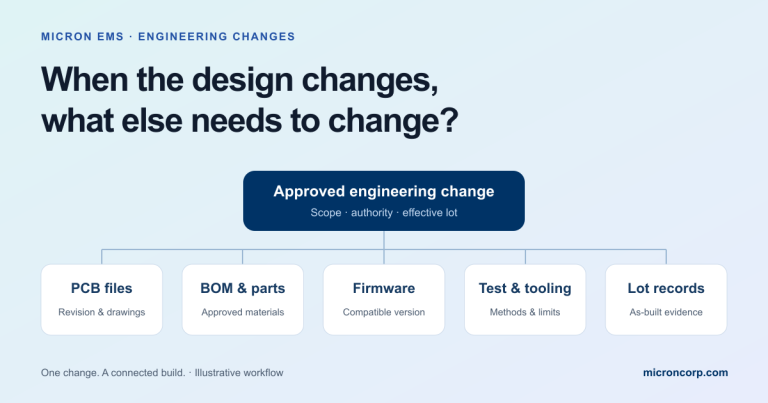
If an issue changes the product or how it is built, ask what needs updating before work resumes. Your manufacturer may need revised instructions, tooling, or checks; your team may need to approve a drawing or provide missing information.
| Review outcome | What to agree with your manufacturer |
|---|---|
| Ready for the next steps | Which product version and work are approved, the evidence supporting the decision, and who approved it. |
| Resolve a finding first | What needs correcting, which work must wait, who will resolve it, and what you need to see before approval. |
| Some work may continue | The specific work that may proceed, its limits, the items still open, and the required authorization. |
The agreed process and terminology should fit your project, contract, and quality requirements.
Six things to agree with your CM before the review.
Explain what you expect to receive.
Describe the finished scope, quantity, variants, included items, and any important installation needs.
Share the build information you have.
Provide current files, drawings, parts, software, and known requirements. Identify what is still being decided.
Agree what your CM will send back.
Choose the results, photos, records, or sample needed for your team to make an informed decision.
Name who can respond and approve.
Identify the right people on your team and agree when they will review the information.
Make unfinished decisions visible.
List what needs resolving, who will provide the answer, and whether it affects the next build steps.
Confirm how approval will be recorded.
Agree which work may proceed, what must wait, and how both teams will receive the decision.
A useful closing question: “Do we both know what happens next, what remains open, and who is responsible for the answer?”
Before you hand over a build.
Can I start the conversation if my build package is incomplete?
Yes. Share what you have, explain what the product should do, and identify the decisions still open. Ask your CM what information and approvals are needed before building and testing. Our guide to preparing an EMS quote request gives you a practical starting point.
Will I review one unit or several?
Agree this with your manufacturer based on your product, its variants, and the required checks. One unit may not represent every configuration in your order. Ask which units will be presented and what the review is intended to demonstrate.
Is this the same as a formal first article inspection?
Not automatically. A first finished unit review is a planned checkpoint with an agreed scope. If your contract requires a formal first article inspection or another specific approval process, tell your manufacturer early so the required checks and records are included.
Does my manufacturer have to stop while I review the unit?
That depends on the plan you agree together. Confirm which operations may continue, which must wait, and who can authorize a change. Agree a response time for your review so the build schedule reflects that decision. Silence should not be treated as approval.
Connect the review to the next build.
Carry approved instructions and useful build records forward.
Read the article →Beyond the boardReview the complete deliverable.Connect the electronics to wiring, enclosure integration, and pack-out.
Read the article →When a finding changes the buildKeep the release coordinated.Follow an approved change through files, materials, software, and testing.
Read the article →